FULL-STACK APPLICATION · Oct 2025
CATSY COFFEE
A multi-platform cafe operations system featuring a FastAPI backend, a React web storefront, and an offline-first Flutter POS. Processes 50+ orders daily and loads in under 1.2s.
The Problem
A local cafe struggled with dropped orders and slow processing times during frequent internet outages. They relied on manual paper backups that failed to sync with their digital inventory, leading to lost revenue and operational chaos during peak hours.
The Decision
Offline-First Architecture
I decided to build a 3-tier system emphasizing reliability. The core is an offline-first Flutter POS app that seamlessly falls back to a local SQLite database (via Drift) when the connection drops. All transactions are queued locally and synchronized automatically to a Supabase PostgreSQL backend via WebSockets once the internet is restored.
Tech Stack
The Outcome
Impact & Performance
The system successfully eliminated data loss from dropped connections. It reliably processes 50+ orders per day without downtime. The customer-facing React storefront loads in under 1.2s, and leveraging Firebase Cloud Messaging (FCM), staff receive instant background notifications for new orders across all devices, streamlining the entire service flow.
System Documentation
# System Architecture: Catsy Coffee ## 1. High-Level Architecture Catsy Coffee operates on a robust, multi-client ecosystem. It features a React-based web storefront for customers, a Flutter-based mobile POS application for staff, and a centralized FastAPI backend. All clients interface with a shared Supabase instance for authentication and relational data storage. ```mermaid graph TD Client_Web["catsy-web (React/Vite)"] -->|HTTP/REST| API["catsy-backend (FastAPI)"] Client_Mobile["catsy_mobile (Flutter)"] -->|HTTP/REST| API Client_Mobile -->|Direct Sync| DB[("Supabase DB")] API -->|Service Role| DB API -->|Auth| Auth["Supabase Auth"] Client_Web -->|Auth| Auth ``` ## 2. System Architecture 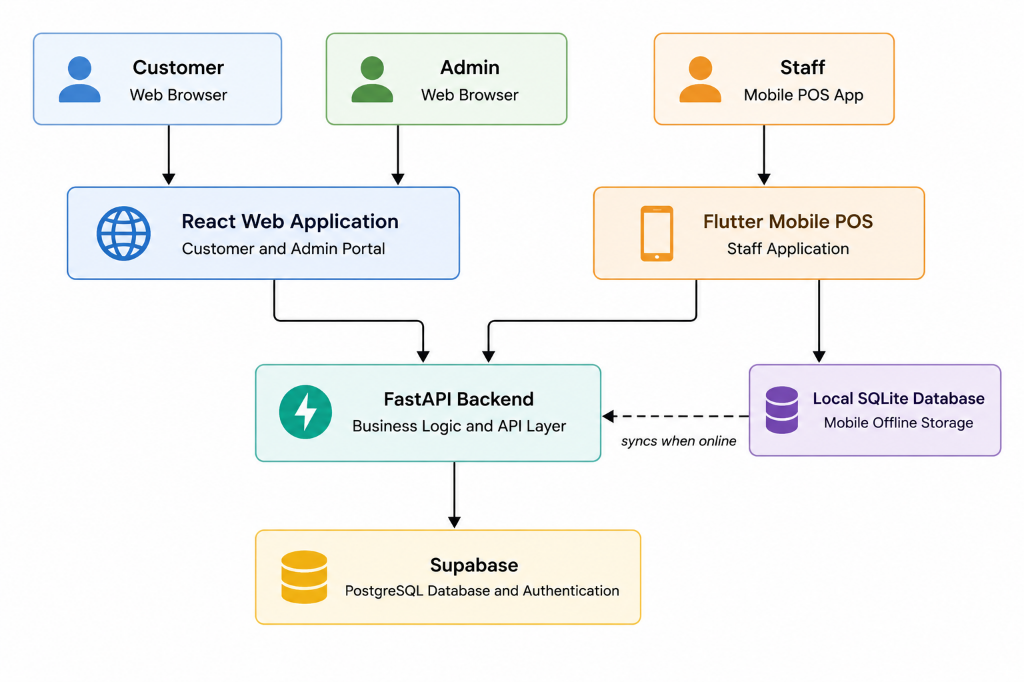 ## 3. Data Flow Diagram 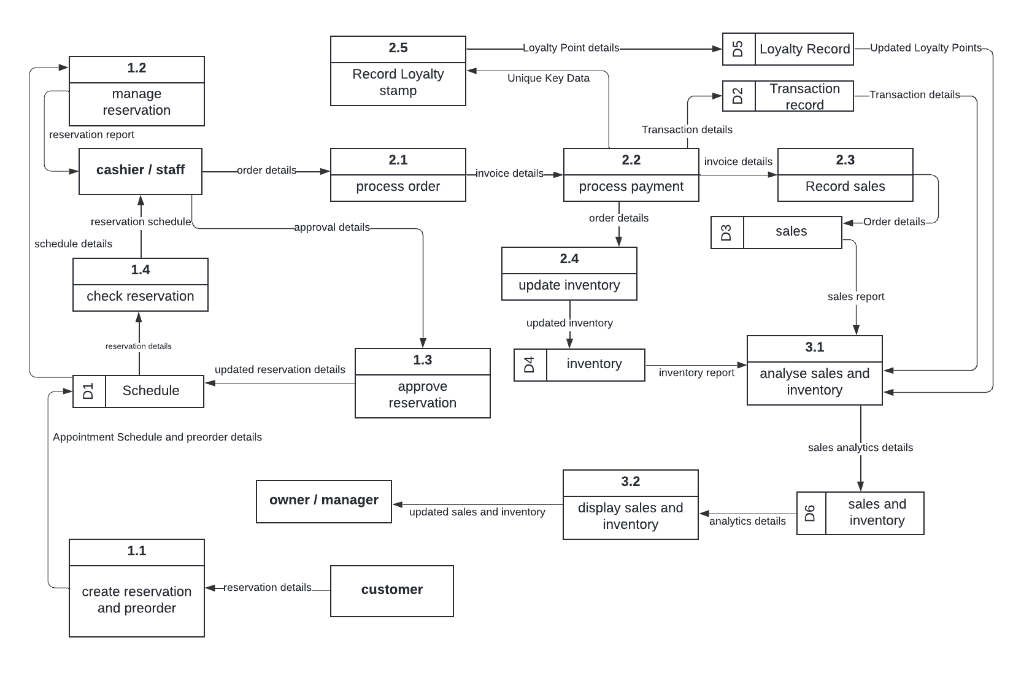 ## 4. Tech Stack & Trade-offs * **Backend: Python (FastAPI)** * *Trade-off:* Chosen over Node/Express due to Python's strict type-hinting via Pydantic and rapid API generation (automatic Swagger docs). It natively handles complex asynchronous task queues (like SSE streaming for order updates) with `asyncio`. * **Web: React + Vite 7** * *Trade-off:* React provides a massive component ecosystem, while Vite ensures instant Hot Module Replacement (HMR). Next.js was intentionally avoided to keep the storefront as an aggressively cached Single Page Application (SPA), lowering server rendering costs. * **Mobile: Flutter (Dart)** * *Trade-off:* Allows a single codebase to compile to both iOS and Android natively. Used specifically for the staff POS to leverage native device features like hardware barcode scanning and push notifications. * **Database: Supabase (PostgreSQL)** * *Trade-off:* Provides out-of-the-box Row Level Security (RLS), JWT-based authentication, and realtime webhooks. It acts as both the database and the auth provider, reducing architectural fragmentation. ## 5. State Management & Security **Authentication Flow:** Authentication is decoupled from the FastAPI backend. Both the web and mobile clients authenticate directly via **Supabase Auth** to receive a JWT. The backend API is secured using middleware that decodes and validates this JWT on every request, verifying the user's role (Customer vs. Staff) before allowing database mutations. **Mobile Local State (Drift & Freezed):** The Flutter POS app requires offline resilience. It uses `Drift` (a SQLite wrapper for Dart) to cache the menu and active tables locally. Complex state models are strongly typed and made immutable using `Freezed`. ## 6. Core Business Logic: Network Independence The most complex architectural challenge was ensuring the Flutter POS app could seamlessly connect to the FastAPI backend dynamically, regardless of the network environment (Local Dev, Physical Phone on Wi-Fi, or Production). * **Dynamic API Bridging:** The app injects `--dart-define=API_BRIDGE_BASE_URL` at compile-time to allow developers to hot-swap between `localhost`, a physical `LAN IP`, or the production `Render` URL without changing hardcoded strings. * **Order Streaming:** The POS uses Server-Sent Events (SSE) from FastAPI to receive instant updates when a customer places an order via the React web app. ## 7. Deployment & CI/CD The ecosystem is deployed across three distinct platforms: 1. **Frontend (catsy-web):** Deployed to **Vercel** as a static build, optimizing edge-caching for customer assets. 2. **Backend (catsy-backend):** Deployed to **Render** via a Blueprint `render.yaml` configuration, exposing the Python Uvicorn server on `$PORT`. 3. **Database:** Managed securely via **Supabase cloud**, utilizing `public.device_tokens` for FCM push notifications across staff devices.